From archival files to ARCO datasets without duplication
Sean Harkins / Aimee Barciauskas · Development Seed
The problem
Reading earth science data is hard
Every format in the archive carries its own internal layout, and the only
thing that understands those layouts are format-specific drivers.
HHDF5 / netCDF
B-tree chunk indices, superblocks, filter pipelines. Read through the HDF5 C library.
GGRIB
Self-describing message stream. Every message has to be scanned to know what is in the file.
CCOG
TIFF IFDs and tile offset arrays, read through GDAL.
Every one of these formats is, underneath, the same thing: a
chunked, compressed array. These drivers tell us which bytes hold
the chunks we need to access and how to retrieve them.
The problem
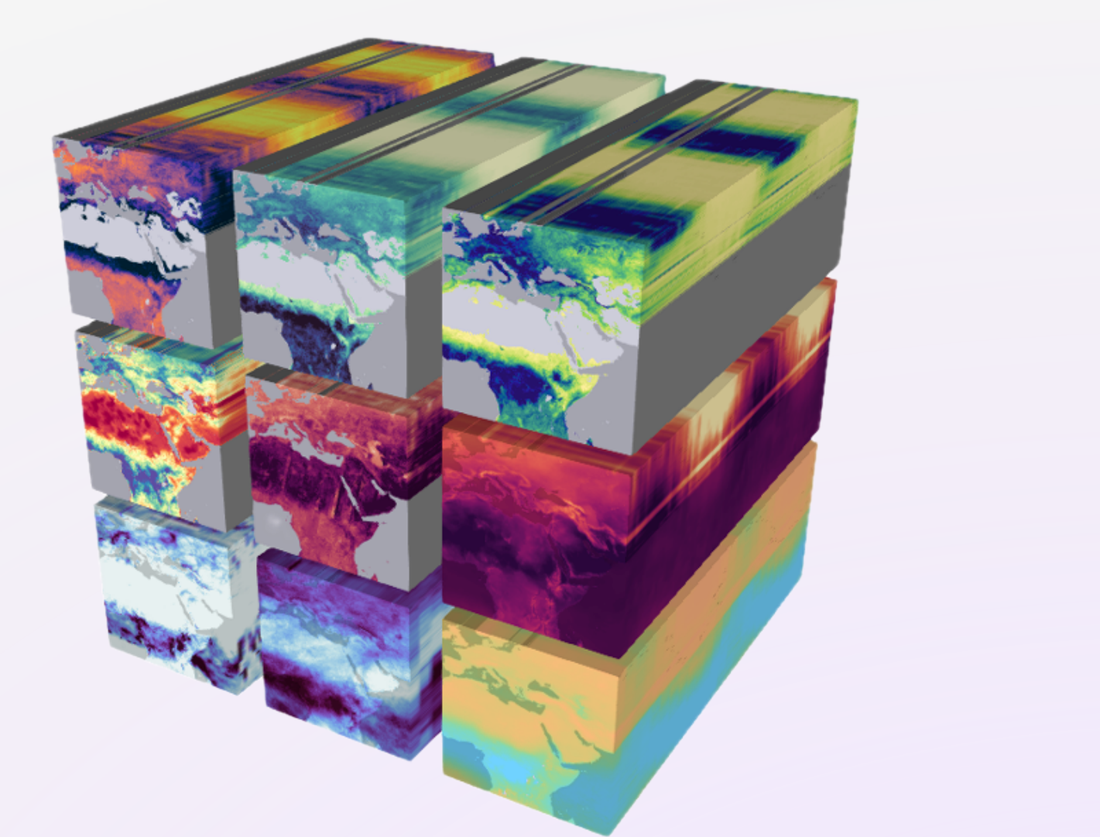
A pile of granules is not a cohesive dataset
Nobody wants to parse, manage and reason about thousands of individual granules.
They want one analysis-ready, cloud-optimized dataset they can query and access
AAnalysis ready
All timesteps and variables organised into a single logical object.
CCloud optimized
A single metadata read supports accessing just the bytes needed.
The conventional way to get
this is to rewrite the entire archive into Zarr:
a second full copy, a second storage bill, and an ongoing synchronisation problem.
Image credit: Mahecha et al. 2020, doi:10.5194/esd-11-201-2020; slide adapted from Ryan Abernathey / Earthmover.
The goal
Forget files and formats
The goal is for users and
applications to forget that there are files and formats and start working with
datasets.
What is virtualization?
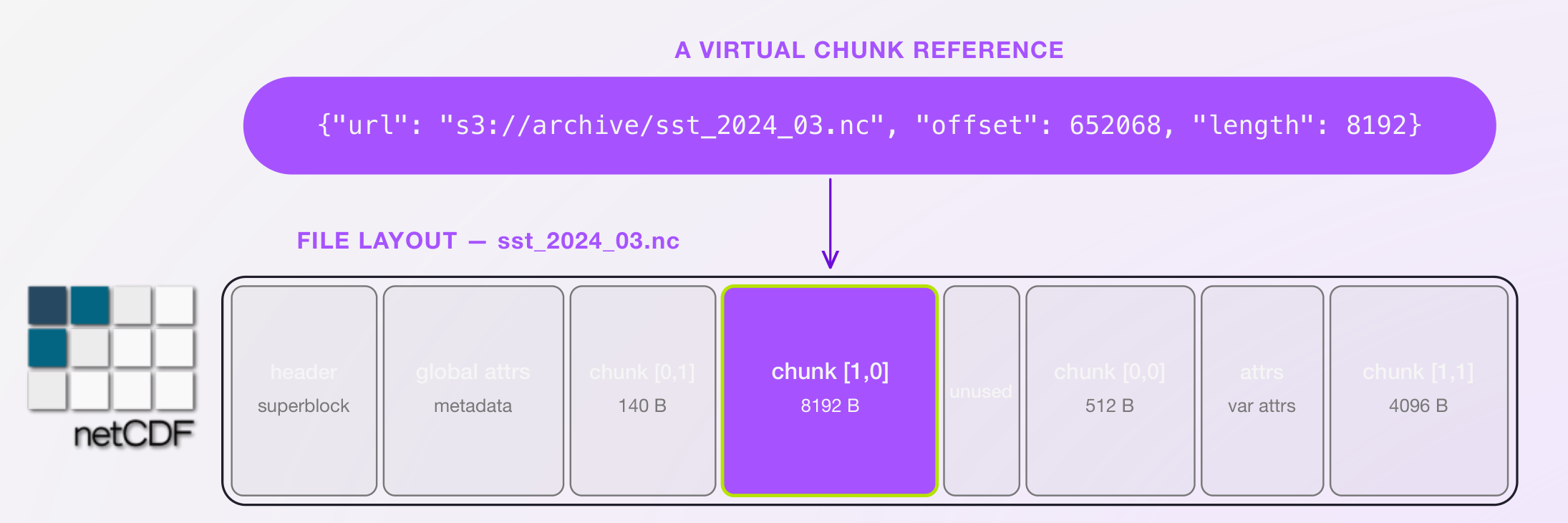
A map of where the chunks already are
HDF5, netCDF, GRIB and COG are all, underneath,
the same thing: a chunked, compressed array. Virtualization parses a file
once, and writes down where each of those chunks starts, how long it is, and how it is encoded.
1It works for any chunked, compressed format
If a chunk's bytes can be located and decoded on their own, the format can be virtualized.
2Creating the chunk manifest happens once.
Readers have access to the logical data cube immediately. Virtual store readers never load the HDF5 library, GDAL or ecCodes at all.
3Access becomes a range request
Fetching a chunk is an ordinary HTTP range request against the original file.
That map is called a chunk manifest.
Virtualization creates the same generic chunk map for different formats
Chunk manifest
This Chunk Manifest is composed of Virtual Chunk References
A virtual chunk is a pointer, not a copy
Chunk reference
Diagram: Tom Nicholas / Earthmover, Virtual Stores: From Theory to Production. Used with permission.
Files -> Dataset
One dataset, made of many references
A virtual store is a chunk manifest that points into
many archival files at once.
◆It looks like an ordinary Zarr store
◆No bytes were copied
The store is references plus a tiny amount of metadata. The extra storage cost is marginal compared to the archive itself.
◆A pile of
granules becomes a datacube
Users and applications load only the pieces they need.
Files -> Dataset
Demonstrated at archive scale
Virtualizing one file is
useful. Virtualizing an entire archive changes what users can do.
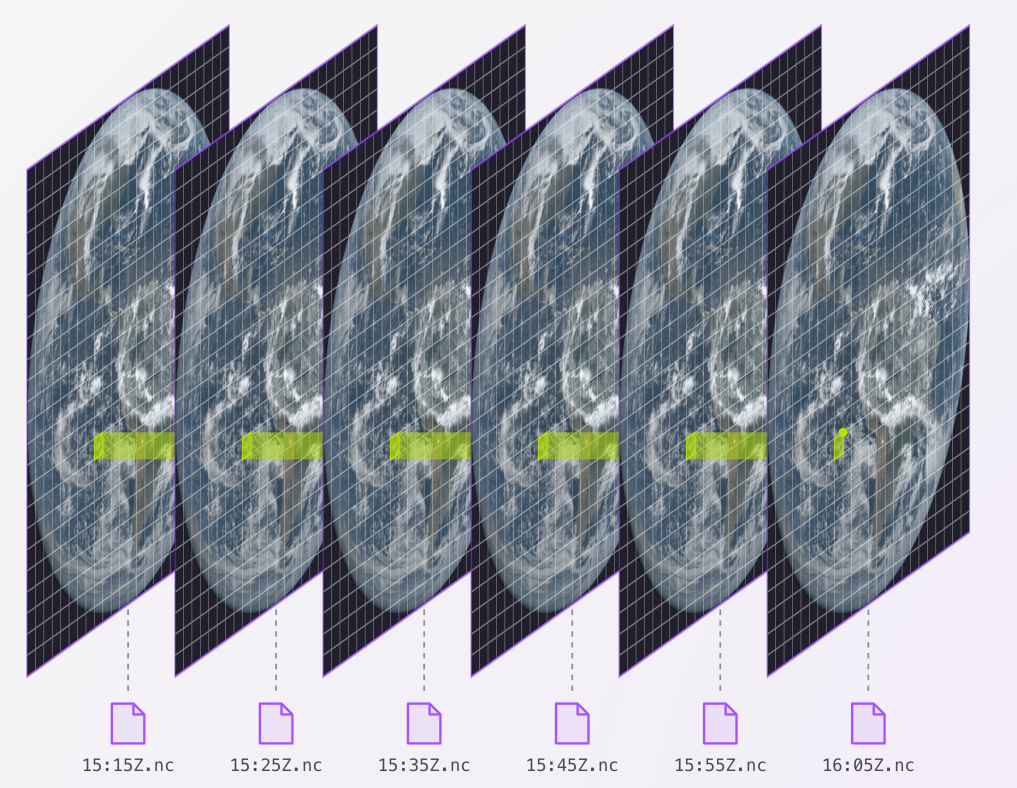
GOES-16
Seven years of geostationary imagery. 300,000 netCDF4 files, 7.1 billion chunks,
one virtual store.
Which means a user can now ask for a timeseries at one pixel across seven
years, a question that was effectively unaskable when the answer was spread over 300,000 files.
Diagram: Tom Nicholas / Earthmover, Virtual Stores: From Theory to Production. Used with permission.
Files -> Dataset
Measureable performance impact
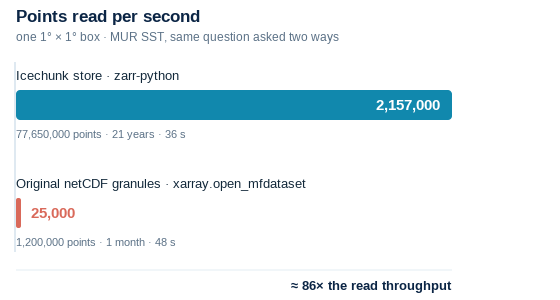
Using MUR SST, we built a timeseries for one
1° x 1° box, once from the Icechunk store and once from the original
netCDF granules with xarray.open_mfdataset.
Same spatial extent, two time series
21 years — 77,650,000 points — in 36 s from the Icechunk store. 1 month — 1,200,000 points — in 48 s from the original files.
~ 86xmore points read per second
However this is not a clean test of virtualization alone, because
this store mixes native and virtual chunks, so it measures Icechunk as a solution for mixed stores
rather than virtual references alone. Notebook:
earth-mover/icechunk-nasanotebooks/mur-sst/read_virtual.ipynb.
Files -> Dataset
A fully virtual store: GPM IMERG
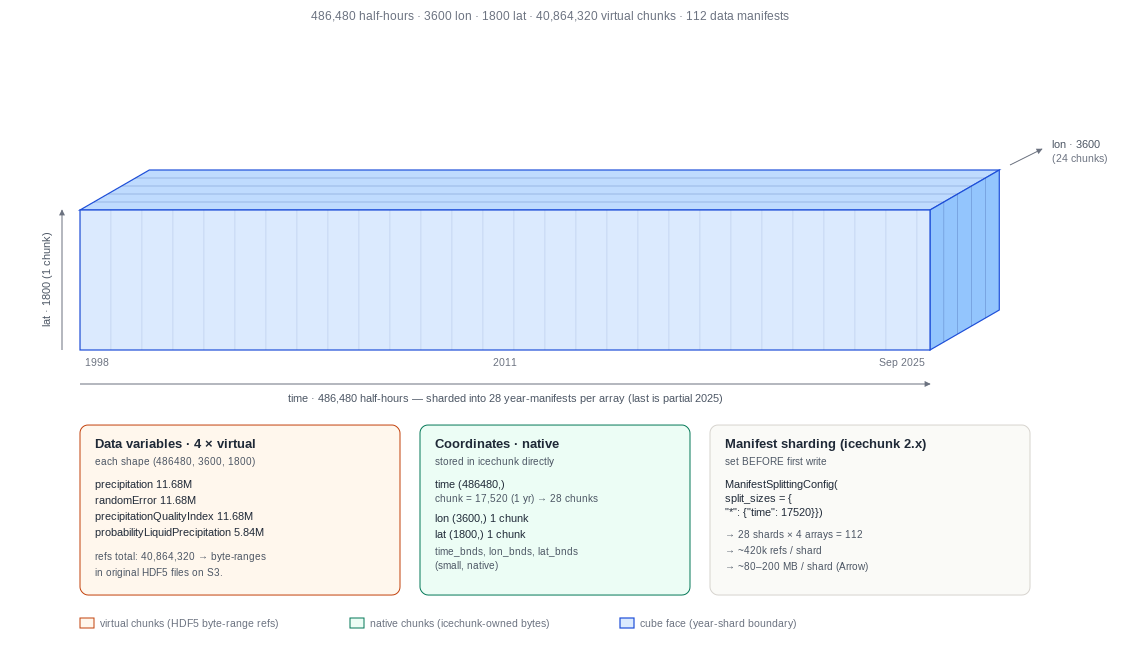
We also built an icechunk store for half-hourly GPM IMERG, fully
virtual: 486,480 timesteps, 40.8M virtual chunks into the original HDF5 granules on S3, only the
coordinates native. In testing, opening + reading one day of precipitation was 45x faster using the virtual store over the xr.open_mfdataset with the original granules.
Virtualization is aligned with NASA SMD's Strategy for Data Management and Computing to Accelerate Scientific Discovery 2025–2030
Finding 2c (Optimized Data Access and Formats): “The evolution from
download-centric models to direct, indexed access offers numerous advantages: chunked organization, parallel processing capabilities, [and more].
However, NASA has not yet implemented these optimizations for most historical datasets … This gap … forces
inefficient data duplication by users requiring high-performance access.”
Recommendation 2c:SMD
should assess which datasets would benefit most from enhanced access methods and data formats to support
modern scientific workflows, then develop a prioritized plan for implementing these improvements.
Virtual Zarr stores offer a direct response to
Recommendation 2c.
◆Unlocks chunked organization
Many archival files are already chunked and compressed. Virtualization exposes that structure as
direct, indexed access over range requests, instead of rebuilding it.
◆Removes the reason to duplicate
Users copy and reformat today because the archive is not directly accessible.
◆Prioritizable, dataset by dataset
Built one collection at a time, with no change to how any mission produces data.
Prior art
Virtualization is not a new idea
1OPeNDAP DMR++
Writes the chunk map for an HDF or netCDF file into a sidecar XML document
that sits alongside the granule. Long-standing, and already deployed across NASA DAACs.
One sidecar, one granule.
2Kerchunk
Writes the chunk map as
JSON or Parquet, readable as a virtual Zarr store through a
dedicated Python interface. Crucially, it also lets you combine many references along a shared dimension
to form an n-dimensional cube.
The first system to treat an archive as a single dataset.
Both of these pioneered the
concept of virtualization but had some limitations that needed to be
addressed.
VirtualiZarr
Deliberate changes
Tom Nicholas (Earthmover) started VirtualiZarr to address exactly
the challenges with existing virtualization approaches.
1Compact representation
Kerchunk's JSON and DMR++'s XML both spend a lot of characters describing each chunk. VirtualiZarr's manifest structure is the most memory-efficient representation
possible.
2Plugin software architecture
Format parsing is a separate, swappable component. The community owns and maintains the parser
for its own format (HDF5, GRIB, TIFF, FITS) without touching the core
library.
3Xarray compatibility
A ManifestArray is an Xarray compatible array. So concatenation and combining are done with Xarray's
existing logic. No server is required.
The third change is the one that
matters most in practice: the Xarray API is familiar and robust.
If you can xr.concat a dataset, you can build a virtual cube.
Prior art
Manifest formats, side by side
DMR++
Kerchunk
VirtualiZarr + Icechunk
Serialized as
XML sidecar
JSON / Parquet
Flatbuffers
Efficient at archive scale
no
Parquet only
yes
Combines files into one cube
needs a server
yes
yes, via Xarray
Serverless access
no, needs Hyrax
yes
yes
Mixed native + virtual chunks
no
no
yes
Transactions and versioning
no
no
yes
Comparison adapted from Tom Nicholas / Earthmover, Virtual Stores: From Theory to Production.
VirtualiZarr
How does VirtualiZarr work?
Parse. Point a format parser at an archival file. It produces a Zarr array representation of
each variable in that file, plus the map of where every chunk lives.
Combine. Do that for many files, then use Xarray to concatenate the virtual arrays
along a shared dimension, usually time, into one n-dimensional cube.
Persist. Everything so far has been in memory. Now it has to be written somewhere durable
that other people can open.
Steps 1 and 2 are VirtualiZarr. Step 3 is where Icechunk comes in.
VirtualiZarr -> Icechunk
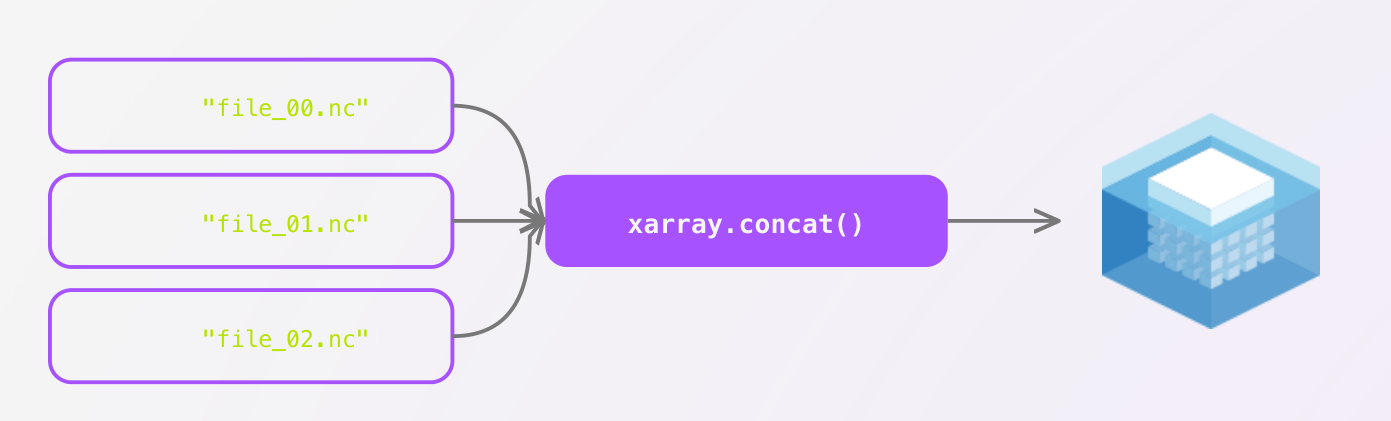
Many files in, one data cube out
Diagram: Tom Nicholas / Earthmover, Virtual Stores: From Theory to Production. Used with permission.
VVirtualiZarr
Parses archival files, organises them into one datacube using the Xarray API, and writes the virtual
references out.
IIcechunk
Stores those references in object storage as manifests, and serves them back through a generic Zarr interface.
Icechunk
Zarr is a format, not a database.
Earthmover built Icechunk because organisations running Zarr in
large-scale operational workflows kept hitting the same wall: the Zarr format on its own makes no promises
about safety, consistency or reproducibility.
!What plain Zarr does not give you
A failed write leaves the store partially updated, with no way back.
A reader mid-write sees some new chunks and some old ones.
No way to say "the version of this dataset I published against".
→
◆What Icechunk adds
Safety: recover corrupted or deleted data from version history.
Consistency: readers always see a complete, valid snapshot, never a partial write.
Reproducibility: reference any version permanently by commit or tag.
Git-like snapshots plus ACID transactions, implemented in Rust,
serverless, on ordinary object storage.
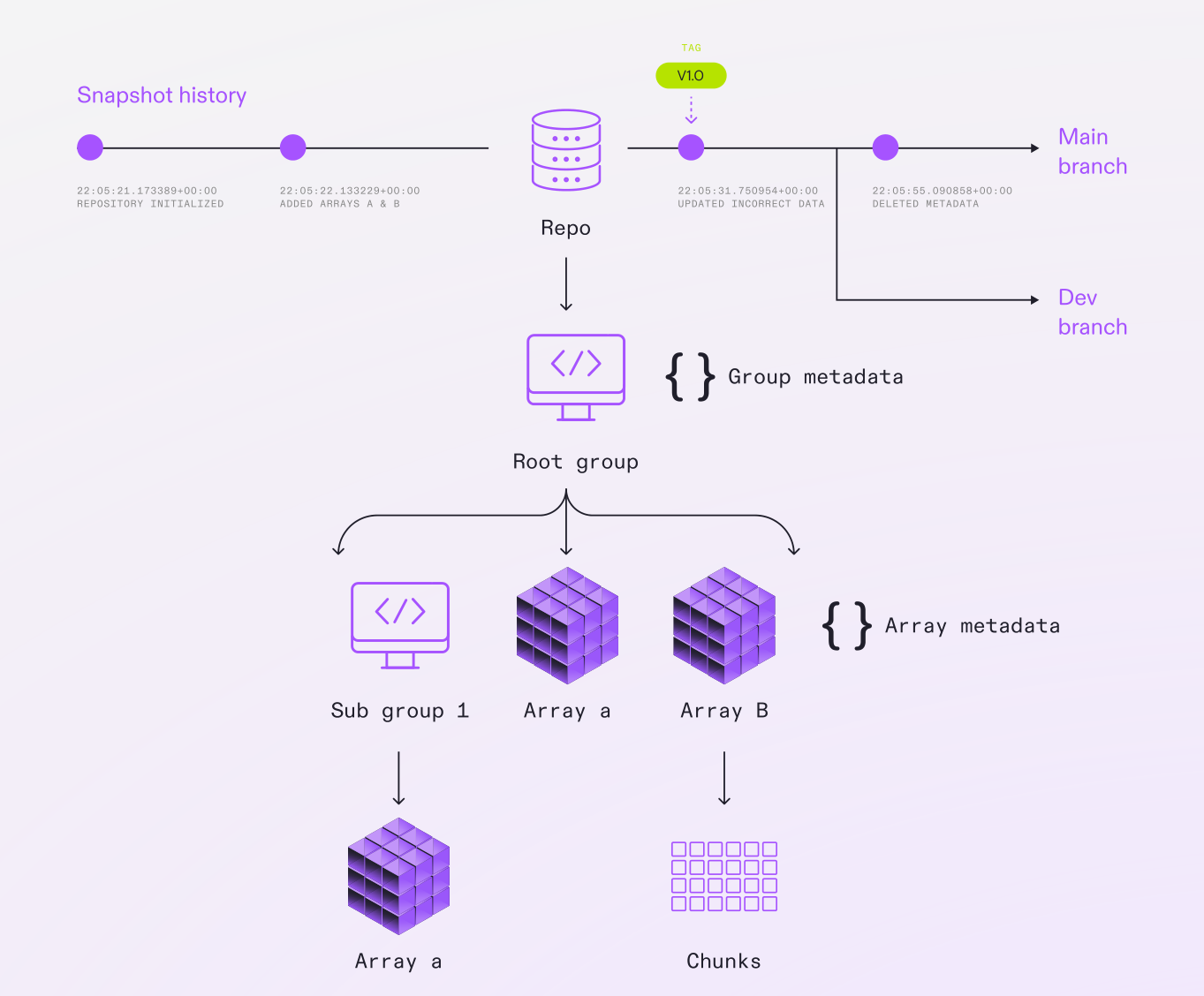
Icechunk
Snapshots, branches and tags over object storage
AACID transactions
In a distributed context: many writers, one consistent result.
VVersion history
Snapshots, branches and tags, with optional expiry and garbage collection.
MMetadata operations
Move, shift and reindex without rewriting chunks.
VVirtual chunks
Pointers to numerical data in external files: netCDF, GRIB, and the rest of the archive.
Diagram: Ryan Abernathey / Earthmover, The Future of Earth System Data Infrastructure. Used with permission.
Virtual chunks
A layer of indirection is all it takes
Icechunk already had to put a manifest between the client and the bytes, so that a
transaction could redirect a chunk atomically. Once that indirection exists, the target can be anywhere,
including a byte range in a legacy HDF file on S3.
Virtualizarr → Icechunk
Virtualizarr allows you to fix archive structure without touching the data
Diagram from Tom Nicholas / Earthmover, Virtual Stores: From Theory to Production.
1Metadata inconsistencies
The virtual store can rewrite names, units and attributes arbitrarily. temp and rainfall become temperature and precipitation without editing a granule.
2Bad files
A corrupt or inconsistent granule's chunks can be selectively overwritten with new native chunks. This is what mixed chunk types buy you.
3New granules
Virtually ingesting a newly arrived file is an ordinary atomic commit.
Limitations
You inherit the chunking you were given
This is the direct cost of not duplicating data. The chunk
boundaries in the source granules are the chunk boundaries you get forever.
⚠If the source chunking is bad
A granule chunked as one chunk per full spatial grid means a timeseries read still pulls the whole grid
for every timestep. Virtualization cannot rechunk, because rechunking means writing new bytes,
which is exactly the thing we are avoiding.
◆What you can still do
Write native chunks for the access patterns that
matter most. Capture the archive with virtual chunks. You pay for a copy only when there is a clear benefit.
Chunking decisions made at production time
have the biggest impact on how usable that data will be over a network.
Limitations
A virtual store assumes the files never change
A virtual reference records where bytes live.
It does not own them. If a granule is reprocessed or replaced in place, those offsets and lengths may now
describe something else entirely.
◆The good news: it fails loudly
Icechunk stores a checksum with every virtual reference and validates it on read. If the
source file has changed, the read raises an error. It does not quietly hand back bytes that are
no longer the data they claim to be.
⚠The cost: a loud failure is still a failure
From the user's side the dataset is simply broken until someone fixes it. The store has gone
stale relative to the archive, and nothing about the guarantee repairs it.
Which makes this an operational requirement, not just a caveat:
our virtualization pipelines have to notice that a granule was updated and rewrite the affected references
so the store keeps up with the archive.
Limitations
Chunks across files must be homogeneous to be combined
To concatenate into a single virtual cube, chunks must be homogeneous
along every axis that is not the concatenation dimension.
1Codec chain
The same compressor and filters, in the same order.
2Data type
The same dtype across every granule.
3CF encoding
The same scale factor, offset and fill value conventions.
4Grid / CRS
The same grid and the same coordinate reference system.
As an example, MUR SST has inconsistent chunk shape and compression
codecs. A store with mixed native and virtual chunks was created.
These restrictions are part of the Zarr specifcation and could
potentially be changed or softned in future versions.
Limitations
Much of NASA's data is not homogeneous
Level 2 and swath products are the hard case, and they are a large
share of the archive. Let's take Harmonized Landsat Sentinel (HLS):
1The CRS changes with location
Granules sit in different UTM zones depending on where on Earth they were acquired. They cannot be
assembled into a single data cube, because there is no single grid to assemble them onto.
2The interesting metadata is not a dimension
Users want to filter on cloud cover, solar angle, processing software version: per-granule attributes
that do not express naturally as coordinates on an array.
The granules can't form a single
data cube. So we invert the approach: virtualize granules individually, and use a
metadata index rather than dimension coordinates to find the chunks we want.
Open work
Two halves that have to stay in step
1The virtual datasets
Per-granule virtual representations. Cheap to create, cheap to store, individually addressable.
2The metadata index
Spatial extent, time, cloud cover, solar angle, processing version: the fields users filter on before
they touch any array.
The open question is what system manages both halves
together, cohesively, so the index and the virtual data remain synchronized.
We have several research efforts under way on the optimal approach for
this type of hybrid system.
Part two
What can virtualization unlock at NASA?
Simpler access, a cheaper bill per request, reduced pressure on CMR, and event-driven pipelines.
Unlock 1
One API instead of one per format
⚠Today
Users must learn multiple format-specific driver libraries.
Even when the driver is hidden behind Xarray, getting good performance means understanding a
stack of client, driver and I/O settings that interact in non-obvious ways.
Engineering teams carry a separate code path per format in every application.
→
◆With virtualization
Users and teams only need to understand the Zarr structure and API.
Every performance improvement in a Zarr client immediately benefits every format, instead of
needing to be delivered in each driver and I/O library.
Applications only require one code path for Zarr integration. This results in real, recurring engineering cost savings.
Today our optimisation effort
is divided across HDF5, GDAL, ecCodes and fsspec. After virtualization library improvements are concentrated on Zarr clients.
Unlock 2
Cloud-native access is cheaper, request by request
Many users today pull whole granules to read a fraction
of what is inside them.
1One read
A conventional reader fetched 1.00 GB to answer a question that needed
128 MB. Eight seconds against one.
2Every read
The counters are cumulative. The gap does not hold constant, it compounds with each
request the archive serves.
3Every user
Egress of re-reading the same granules are what an archive actually pays for.
We have known for awhile that
cloud-native access is cheaper. But making it the most attractive option
for users has been difficult. Datasets over files can increase this
adoption
To locate data for a time and place, users and applications
query CMR, directly or through tooling like earthaccess, and get back a list of granules
to download or subset. That metadata index is a server, and it absorbs the full weight of every question anyone asks.
A single, ordinary question
Plot a timeseries at one point, for the full length of
the GOES-16 archive.
> 300,000files returned by CMR, to answer a question about one pixel
And that is one user, one point, one variable. Multiply by the user base
and by every application built on top of CMR.
Unlock 3
Let object storage carry the index
An Icechunk array's dimension coordinates are themselves data in object storage,
so they work as a searchable index at S3's scale, not the scale of CMR's
server infrastructure.
Unlock 4
Datasets that can emit events
Many of the systems we build have to react when data is created,
updated or replaced. CMR has limited pub/sub today, but it notifies at the file level. Icechunk commits live in
object storage, so we get native S3 notifications, at the chunk level.
Unlock 4
Three things that follow immediately
1Edge caching
Frequently accessed chunks can be warmed at the edge as they are written: lower latency for users
and lower egress cost for us, driven by what is actually being read.
2Notify, don't poll
Tell users when new data lands for their region and time of interest, rather than having thousands of
clients poll CMR on a timer to find out.
3Derived products stay in sync
Accumulated or reduced-resolution versions for visualisation are rebuilt on commit, so they are
automatically consistent with their source instead of drifting.
Notice that the second one is a reduction in CMR load too. Polling is a
large fraction of what a metadata server absorbs, and it exists only because there was no way to be told.
Part three
What could a future data system look like?
Follow the argument one step further than
virtualization actually requires, and then come back to why virtualization is the way to get there.
Future
Integrated ingest and archive
With atomic transactions as the foundation, a mission system
could write granule data directly into a Icechunk datacube rather than producing files that a separate pipeline
then has to catalogue.
1A transactional pipeline with no extra database
Mission systems get commit semantics from the data store itself, without standing up separate pipeline
management infrastructure alongside it.
2One logical entrypoint per dataset
A collection is a store, rather than an unstructured set of files that needs separate index
infrastructure before anyone can find anything in it.
3One API for finding and for reading
Search and access stop being two different systems with two different clients.
4Each collection scales independently
A store per collection distributes the load, instead of concentrating concurrency and scaling pressure on
centralised ingest, archive and metadata systems.
Transitioning
Virtualization is the bridge, not the destination
⚠Why we can't just go there
Missions have neither the incentive nor the resources to adopt new data store
technology mid-flight.
The user community has not fully adopted cloud-native patterns, and still thinks
in files rather than datasets.
Testing and socialising new technology at agency scale takes years, and should.
◆What the bridge gives us
The data system keeps operating exactly as it does today. Missions produce
the files they already produce. Nothing is asked of them.
Meanwhile users get the cube, and we get to demonstrate the power, the cost
savings and the simplicity of an integrated store on real collections.
All with no data duplication, so the cost of being wrong is low.
Virtualization lets us test
our concept with evidence instead of slides, on real NASA data, at a cost we can walk away from.
Today
Virtualization at NASA today
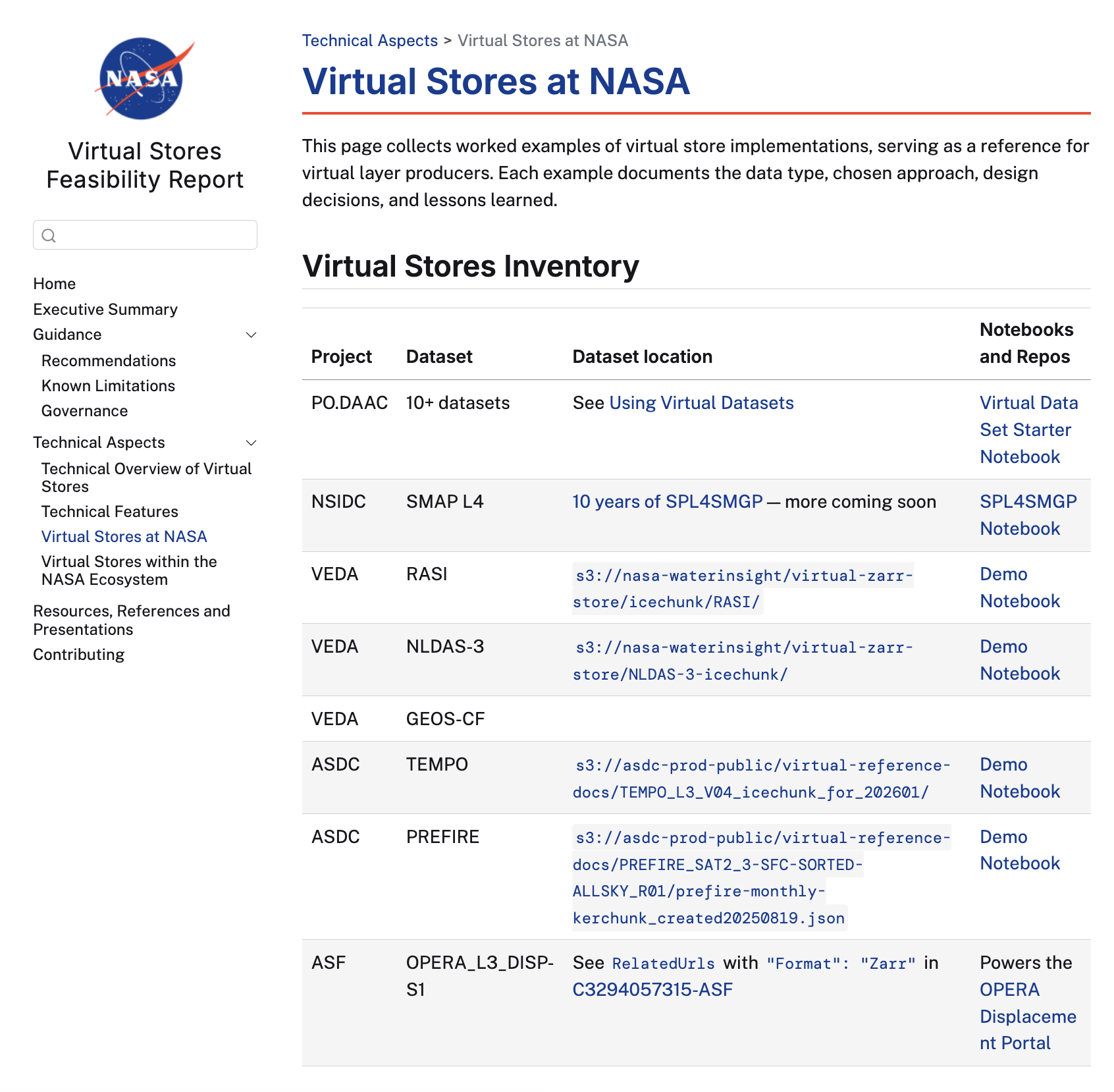
Virtual Stores Feasibility Report, Virtual Stores at NASA
Virtualization is already being adopted across NASA Earth
Science. The feasibility report keeps a running inventory: PO.DAAC, NSIDC, VEDA, ASDC and ASF,
each with a store you can open today.
Today
virtualizarr-data-pipelines
A reusable infrastructure template for standing up and operating a
virtual store that we've used to create stores for VEDA.
1Backfill at archive scale
Creates the AWS infrastructure for executing full archive
virtualization backfill jobs with massive
parallelization.
2Keeps the store current
Handles updating the store as new granules are
published, so the store is fully synchronized.
3Users bring their domain expertise
Lets template users focus on the logic specific to their dataset without having to think about
infrastructure in detail.
4A central place for
best practices
Captures Icechunk management best practices in a central location, instead of every project
rediscovering them independently.
Open source and yours to fork:
github.com/developmentseed/virtualizarr-data-pipelines
Takeaways
Same bytes, better dataset experience
1Nothing is asked of missions
The archive is untouched and unduplicated. Virtualization is additive, reversible, and cheap to abandon if a dataset turns out not to suit it.
2One structure, one API
Users and engineering teams learn Zarr once. Every optimisation lands in one place and lifts every format at once.
3A dataset, not a pile of files
Coordinates in object storage carry the index, and commits emit events. That changes what we can build on top.
Where it is still open: heterogeneous, Level 2
data: virtual granules plus a metadata index, managed cohesively
Diagrams marked as such are by Tom Nicholas and Ryan Abernathey (Earthmover), used with permission.
Deck and remaining figures by Development Seed.